Last Life of Leaves

Last Life of Leaves

In the beginning, swirling in the base primordial soup on a barren planet, chaotic elements combined and life appeared. First drifting, then swimming and then crawling from the seas, life began to slither, then walk and then fly. Some took root while others took flight and remaining took shade.

Finally, from this fertile ecosystem, life suddenly began to think. Through the pure process of consciousness, humans elevated themselves above the others and in a blink of an eye took over the Earth.

Mankind expanded from caves and wandering to huts and conquering. Cities began to spring up everywhere and grow exponentially into the wilderness like some leviathan eating up everything in its path. Industry consumed the rest of life as some were killed for food, some were cut down for materials and others were destroyed by mistake.

Somewhere amidst this destruction, though, mankind became aware that their future depended on the survival of the rest of the planet as well.

At first, that meant cutting down fewer rainforests and protecting species for extinction. But this was not enough, so man began to use the natural resources that the planet had made freely available for millennia, most notably the Sun.

Oil and coal became unfashionable, then illegal and then were forgotten. Nuclear was abandoned even quicker. And from humble beginnings, solar power rose to cover the planet. Instead of rainforests hungrily consuming the sunlight, endless solar farms of silver, shiny panels were built chasing the Sun around the Earths rotation.

But things did not get better. Mankind’s beast always needed feeding as it expanded upwards and outwards. Other life on the planet slowly disappeared, from the tiny honeybees buzzing between flowers to the massive blue whales frolicking in the dying, polluted ocean being churned up by shipping engines.

In desperation, mankind turned to their legions of revered scientists. These scientists were beings of great intelligence, but little wisdom. Thus, the scientists turned back to the fleeing forms of nature for inspiration, little understanding the risks. Biologies were forged in laboratories as primordial soups were cooked up from the furnaces of dying species and cold matter.

At first, it worked; trees were forged and planted, animals were built and the Earth got a little less silent. But, as with such things, the flaws took some time to appear and, in the end, the trees wilted and died, the animals could not mate and perished, and mankind panicked.

Now armed with the knowledge, but not yet with the wisdom, the scientists turned to mankind’s own biology and began changing things. Perhaps, these misguided men reasoned, if we cannot change our environment to help us survive, we can change ourselves to survive our environment?

Of all the species, the one that lived the longest and needed the least is that of the tree. The barren Earth also had little to give but the sunlight shining down on its miles of wasteland and silted water deep below its blackened surface.

Thus the scientists began splicing photosynthesis into the human genome. They started moulding themselves to survive the consequences of their previous generations’ decisions. Mankind will live on sunlight alone, they proclaimed, immensely proud of themselves.

All it took was three generations before mankind was no more. The Earth had finally given up on them, the food and fresh water had run out and resources were no more. All that remained where those few who had consented to the biological alteration that left them alive, deeply rooted in this barren land with impotent seeds falling to die in the dust.

On that silent planet, these sentinels were the last and, one by one, they too slowly died. The water to their roots turning toxic, the dust in the sky starving them of their food and they withered away to oblivion.

Thus, on one fateful day, the last leaf fell from the last dying branch of the last sentinel on Earth, and she closed her eyes for the last time.

And then the planet was silent.

Dust blew and the oceans raged, slamming against moving shores. Continents drifted and volcanoes erupted spilling their rich loads over the planets. All things eventually slipped back into the ocean and drifted to its dark, silent depths.

And, eventually, in this new primordial soup, chaotic elements combined in mysterious ways. The results of this chaos then opened their eyes for the first time, and the planet was silent no more.

After all, life will always survive, but it will not always be the same life.


Old Roads

old-road

Down the bottom of our smoothly-tarred, modern road and at the quiet beach lying there, there is a rock that runs into the ocean. It is less of a single rock and more a series of tightly packed rocks running in a straight line, like an ancient road. The rocks are old and cracked. They are worn where the wind and water have battered them, but they hold fast where they were laid many ages ago.

No cement or binding holds them there. No tar binds the rocks into this old road running the sea. They just hold there, like some mysterious force was protecting them against the pounding waves, the beating Sun and the blowing wind.

On warm summer days over the weekends, families will flock to the beach. Umbrellas will pop open like blooming flowers displaying various company logos across the sand. Deckchairs will fold out as clothes come off in a near ritual wave of familiarity under the warm Sun and to the tune of the softly, crashing waves in the background.

The children are the first to run to the waters. Shouting at each other, they splash through the cool ocean, laughing and shrieking in delight.

And right in the middle of these trivial excesses and family fun, runs the old, weathered road straight into the ocean.

I wonder what sights this old road has seen?

When childrens’ feet run pattering over it now, does the old road remember soldiers’ boot stomping down it? When children run over it laughing and shrieking amidst their fun, does the old road remember the cries and shrieks of the fallen that walked it, their blood washing over it like the salty, cool sea water does now?

And, sometimes, I even wonder if one day the smoothly-tarred, modern tar road that I walked down to get to this beach will be like this old road. After the inevitable nuclear bombs drop, the virus wipes us out or the climate change starves us to death and the water level rises, will my modern road remain? Will my modern road–by then cracked and old–run down to and under the gently lapping, slightly-radio-active, ocean water? And would the original old road have finally disappeared deep under those dark waters?

Perhaps the old road would finally have been forgotten? Maybe there will be no one left to remember it. Perhaps it will finally have been given to the ocean that it has been leading to for ages. The old road would finally be able to rest at the bottom of the cool sea without any feet running shrieking over it.

And, sometimes, I then wonder how many past ages have come and gone? How many old, cracked roads potentially lie on that ocean floor? How many old cracked roads could there be, and how many feet may have walked them? All these forgotten and all the shrieks of their times lost to us, lying under our umbrellas and on our deckchairs in the sun and drowned out by our childrens’ laughter.

Hands in the Woods

hands-in-the-forest

“Don’t go down to the woods tonight, little girl,” said the grizzled, old man while sucking on his half-lit pipe, “The Sleepers there will be waking from their dark, ageless slumber to dance in the bloodless moonlight like wild dogs. They will drain you of your virgin blood, little girl, because no one has ever come back alive.”

The younger, less-grizzled man next to him chuckled loudly, “No, no, old man! Are you saying that we are a village with only virgins wandering around in our woods? We won’t last this generation if that is true. It has nothing to do with virgins or blood. No, the Sleepers don’t dance and they couldn’t care less about the moon or your sexual proclivities,” the man leaned forward, looking intensely at the young girl, “Sweety, the Sleepers rise from where they once fell on their ancient battlefield to haunt the old willow trees that grew over their graves. They climb the boughs to scout the battlefield. Our woods are a battlefield just as real to them now as it was to them back all those ages ago in whatever ancient kingdom they were once part of. Today is the anniversary of their great, forgotten battle, and so, Sweety, we all huddle up in this warm, cozy bar with everyone and drink until dawn before going back out. The Sleepers will be sleeping once again and all will be fine in this world of ours then.”

“W-what do the Sleepers look like?” the wide-eyed little girl managed to ask the two men before her mother found her and dragged her away to sit with her family. But, this question sparked a heated debate amongst the two men. Soon enough a number of men from other tables joined the debate.

“Dark, twisted, hairy forms with bloated hands that float in front of them,” one medium-grizzled man piped up, “My Cuz told me he once saw them across the river late one night. They float all ghastly-like out there–”

Another man laughed, slamming his tankard on the worn, wooden table, “And how would your drunken Cuz know such things? He was probably pissed and saw your mother fetching water!”

This was met with an uproar of loud laughter and manly back-slapping. Another round of ale was ordered for everyone. The inside of the inn was warm and packed. Most of the villagers were in there that evening. They were all laughing and joking amongst themselves. There was flirting amongst the young and tale-telling amongst the old, but no one was in the mood for anything more.

Outside the night was cold and the woods were dark.

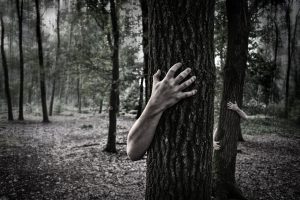
Outside the Sleepers were waking up. They were crawling from their nests inside the unique willow trees that grew in that wood. Their hairy, eight-legged forms had a pattern on their backs in a soft whitish-pink that made them look almost like a human hand from a distance.

A whole forest of hairy, eight-legged human hands was crawling out from their nests in the boughs of the willows. Like some dark and twisted ritual, they all climbed to the tops of their trees. At the top of the trees, poking out above the woods, there was the cold wind that constantly blew from the mountains. It blew down those rugged peaks through this valley and out to the next forest a kingdom away. Each Sleeper would spin an off-white sail, stand up on its back four legs–four other hairy insectoid legs spread upwards–and flick out its sail to catch the cold wind.

One by one, each spider took off, floating upwards and onwards like a silent, hideous, hairy hand over the dark woods. One by one, they would disappear into the night.

Only, nothing really disappears. The Sleepers would reappear, falling from the sky in the nearby kingdom. They would silently fall from the night sky in another wood outside another village that were also huddled indoors telling stories about the annual flight of the Fallers that dropped from the dark sky once a year to steal away mortals caught in their webs…

And, back in the wood in the boughs of those old willow trees, the spiders’ eggs lay awaiting the day in a year’s time when they too could fly to the mating grounds.

The Mysterious Death of Hope

woman-dragging-cross

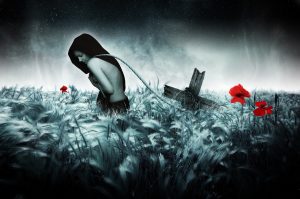
The old man who lived in the woods outside of the village had said that she was born with a curious fate. Her mother had said that is must be something good, and so she had called her “Hope”. The village folk had celebrated her birth briefly before returning to the fields because the harvest waited for neither king nor peasant.

As a young girl growing up, she had been fascinated with the simple folk surrounding her. Something about her had felt different. Something in her had felt apart–more unique–that the simple villagers around her going methodically about their daily lives. They would wake up early and work hard before coming home, eat and drink and then fall fast asleep.

Then they would do it all again.

In the winter, they would huddle together in the small Town Hall, drinking around the great fireplace there and telling tales both tall and true. After the winter food had run out in the spring with empty bellies, they would plow the land till it was raw and cast seed into the wind with prayers of food. In the summer, they would wade back into these now lush fields with sickles and scythes to harvest what they had sown. And, in the autumn, they would eat and drink, pretend the cold winter was not coming and forget about the great labour that would shortly be coming.

And then they would do it all again.

One cold winter’s night, a stranger walked into these mundane seasons of village life.

He appeared on the step of the Town Hall late one icy night. The cold air blasted in from the door and the fire flickered wildly before someone invited him in out of the cold. He stepped in and closed the door behind him. Knocking snow off his black, leather boots he cast his gaze around the dimly lit interior with no tangible expression upon his face.

Hope felt his gaze linger on her, but before she could smile or react the villagers had flocked around the man. Here was something more interesting that tales of earth and grumblings of taxes and age. Here was something more interesting than their neighbors and what happens in the nearby woods.

When the strange man began to speak, Hope crept nearer to listen. She was ashamed to admit that she as was intrigued as her fellow villager. She hated to admit any similarity between her and the simple folk.

Now that she was nearer, she saw how pale and thin–almost gaunt–the stranger looked. He had black, straight hair that cut his near snow-white features as his dark, brooding eyes flickered up to hers for a second.

She was now a young woman, so she could stay in the Town Hall as long as she wanted, but the elders got to speak. And speak the elders did, throwing questions after questions at the stranger. They asked about news of the other villages and how the king was doing. Would he raise their taxes next harvest? They asked how the neighboring lands were doing. How was their harvest? They asked about the rest of the world. They asked and the stranger told them.

Hope began to realize how big the world was and how small their village was. She began to realize that she had seen enough of simple folk. She wanted to see all the fancy folk that this stranger spoke of. She wanted to see the lands that reach out further than the eye can see. She wanted to see the ocean that stretches out further than the mind can fathom. She wanted to see the great river in the East and the rugged, snow-capped mountains in the West. She wanted to dance with the royals, sip from the crystal glasses of the court and whisper intrigue to the king. She wanted to see the foreign kingdoms, dance in the starlit lakes of yonder and walk the bustling streets of the great cities…

Suddenly she realized that everything was quiet. The stranger was standing before her. The elders and the simple folk in the hall were all just sitting and blankly staring at where the stranger used to be sitting. But he was standing in front of her now, holding her head in his cold hands.

“Do you really want to see the world?” he asked looking down at her with an expressionless face, “Do you really want to see everything there is to see?”

Why was everyone just sitting there staring? Why was the hall so quiet? Why did she feel terrified? Why were his hands so cold?

Hope’s mind was screaming. Her fear was rising like a pit in her stomach, but all that came out was a soft whimper and her head nodded slightly.

The stranger smiled. It was not a happy smile nor a cruel one. It was more mechanically with all the right muscular movements, but no real emotion behind it. And it revealed the fangs in his mouth. Hope wondered if they had always been there or just suddenly appeared?

“This pain will release you from your mortal coil, but deliver the world to you,” the stranger whispered as he leaned down to gently bite Hope’s now exposed neck. The sharp pain made her cry out, but another part of her registered that he smelt of roses and ash.

And then Hope grew tired. The cold began to spread across her now-heavy limbs. Her eyes closed and her head slumped forward into the stranger’s arms.

He would carry her from that village. She would awaken six days later in a great, hidden castle many leagues from her old village. She would begin to live a great tale of her own, sometimes wonderful and sometimes dark. Sometimes with kings and courts in it, but sometimes with midnights and winters too. She would swim in the midnight lakes of twilight and dine on the snow-capped mountains while wolves howled in the distance.

She would do all of these things and more, but far away in her old village, two small droplets of blood in the town hall were the only signs that she had ever been there. Her mother would cry herself to sleep, but soon enough the tears ran out. And then the years passed and so did her mother. Her father had already passed with many harvests ago. The elders that were there that night would also soon be buried in the woods with the rest. All of them would be replaced by some of the younger generation, now old with their children’s children around them. Children were being born and the harvest sowed and reaped, as summer would turn to autumn and the cold winter would give way to crisp spring.

And then they would all do it again.

And, after many lifetimes of harvests had passed, no one would remember the girl or the stranger. The village would grow while new generations filled the old cobbled streets that all led back to the old Town Hall. The only fragment of the mysterious death of Hope echoing through the folk songs would be the two dark stains in the old Town Hall where her blood dripped on that cold, winters night.

Dark in the winter when the drinks had flowed and the fire was low, the elders of that generation would point at those two blood stains and talk of the mysterious death of hope. They would talk of how the harvest had died and the cold winter had come early and left late. They would whisper of the devil and the demons that knock at doors late at night. And so the tale would grow, from generation to generation.

Until late one winter’s night a strange, beautiful lady appeared at door of the Town Hall. The cold air blasted in from the door and the fire flickered wildly before someone invited her in out of the cold. She stepped in and closed the door behind her. Knocking snow off her black, leather boots she cast her gaze around the dimly lit interior with no tangible expression upon her strikingly beautiful face.

One of the villagers piped up, asking about the king and the other villages. How had the harvest been in the southern part of the kingdom? The mysterious lady walked to a chair, pausing briefly as she passed the two, faded blood stains on the floor. Was there snow on the mountains yet? She sat down. And then she spoke, her voice strangely familiar to all who listened.

“Why don’t you all tell me about the harvest? Tell me about waking up early and toiling in the earth under the warm Sun? Tell me about a long, honest day’s work and a quiet night’s sleep surrounded by your loved ones? Tell me about your beautiful lives?” The strange lady smiled. It was not a happy smile nor a cruel one. It was more mechanically with all the right muscular movements, but no real emotion behind it. The smile revealed the two, small fangs in her mouth, but no one noticed as all the folks began talking at once about their simple lives in the small village nearby the dark woods.

The Illusionist’s Maze

illusionist

The light of day recedes and a chilly, silence covers the air as you step over the threshold into the infamous maze.

From the outside, it looks just like a dark, overgrown cave entrance in the side of a rugged mountain, but local legend said that an immortal wizard had built the maze out of boredom. Since before the village was founded, he has always lured adventurers into the maze’s clutches with the promise of treasure. But his true aim is just  to amuse himself across the endless ages with the falsely heroic struggles of those who step into his realm.

No one knows how true the legend is, but it is a fact that no one had ever come out of the maze alive. If the ancient, forgotten language chiseled into the rock face is anything to go by, then it is also true that the maze predates the small peasant village a couple miles away. It likely even predates the current line of kings ruling this quiet little land.

A tingle runs down your spine as you pass a decrepit statue of some old man gazing out at some unknown era. The rock is weathered, cracking and covered with moss and ivy, much like the walls of this place. Perhaps he is the wizard, you think, or maybe not. You doubt that you will ever truly know, but the same curiosity that drove you to leave your own small, little farming village and explore the wide world drives you deeper into the dark maw of that ancient structure.

You turn the first corner in the maze and the light and noise of day fades away. It is replaced by a tense, brooding darkness. The chill air is still and the very maze seems to be waiting in anticipation for your next move. It feels like hidden eyes are watching you with ill-intent.

In front of you are three corridors heading off in separate directions. You can instinctively know that only one of these options is the right one, but which one?

You light a torch you are carrying. Its tar-tip splutters to life, casting a flickering, sickly light around you. You check your weapons: your sword is strapped at your side and your dagger is slipped into your boots. You call the former Big and the latter Small, because you are both a practical man and you know that all great adventurers name their blades. It gives the bards something to sing about much later, but all of that is far from your mind right now.

The air from the one corridor smells vaguely of rot and something much, much fouler. The air from the other two corridors smells old, but fine. As you step forward, though, you notice that one of these other two tunnels has deep scratch marks on some of its stone wall and you sense a lurking doom waiting for you at the end of it. It almost feels like you know that you should not walk that corridor.

And so you choose the remaining corridor to follow and begin to walk carefully down it, all the while watching for traps and things far worse. The hair on the back of your neck is raised and you still feel like unseen eyes are quietly watching your every step.

Suddenly you are surrounded by a thousand, dark-eyed rouges. A sputtering torch in their one hand with the other hand hovering over the hilt of a sword at their side.

You smile. This is the first of the illusions. They are all you walking down the corridor that you are walking down. You stop and look carefully at each one of them. They are all exactly the same. They are all your reflections wrought by magic in this dark place.

You take a small step forward. They all take a small step forward. You raise your torch and peer around. They all raise their torches and peer around.

And then you smile and your sword flashes out. Steel shatters the illusion and a terrible howl pierces the heavy darkness of the maze. The one reflection was fractionally too slow to follow your actions. The one reflection did not have the same scar you have just below your chin where a kobold’s wicked claw tore the skin. And the one reflection falls dead at your feet, shifting into a dark, hairy beast with claws and teeth like a mountain bear.

All the magic mirrors on the walls shatter and blow away as foul-smelling dust. The darkness in the maze seems to retreat for a moment like a wounded animal, before rushing back to surrounded you.

Your torch flickers and you are standing alone in the same tunnels again, but with a slain beast at your feet.

You wipe the blood off Big on the beast and sheeth it again. You can feel the comforting weight of Small in your boot. You smile grimly and step over the beast, continuing on your way.

It will take more than that, old man, to trick me, you think, as you wind your way down the dark, endless corridor and deeper into the maze.

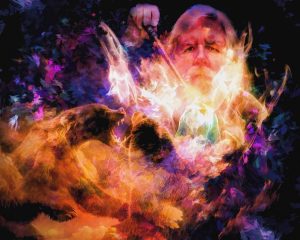
Right at the end of the maze, an ancient old man is standing. His skin is taunt over his bones making his near skeletal features look chiseled into the darkness that surrounds him. Brustling white eyebrows cast his face in more shadows than the darkness and in his hand he holds an old, warn wand with evil runes carved into it. He smiles and looks at the person lying on the altar before him.

The person lying there is you, but your eyes are closed. Your fists clench and you twitch in your dark, enchanted slumber. Your sword, Big, lies impotently broken in three pieces on the other side of the room and your dagger, Small, is nowhere to be seen. A single drip of blood slides from your nose, down your check and drips onto the cold stone altar, sizzling when it touches it.

“He is encountering the cyclops now,” the ancient wizard rasps, an evil smile dancing across his thin lips, “And then it will be the Chamber of Spiders. I wonder if he will die there again? Maybe he will pass that one this time. He did choose the right corridor this time, but how far will he get?”

An evil laugh echoes off the cold walls in that chamber, but you are oblivious as you walk through what you think is the maze.

But what you do not know and what you will never find out, is that you have already walked that maze and you have already come up against the ancient wizard there. And, trapped in his illusion, you will now walk that maze for eternity or until he is bored of you.

Because, that, dear adventurer, is the Illusionist’s Maze: It does not exist, but you remain trapped in it walking it again and again.

And the evil laughter grows louder while you squirm on that altar, mentally battling a great, smelly cyclops in a cramped, dark corridor filled with spikes…