Tag Archives: stars

Manufacturing Stars

There were so many lights flashing that it looked like a cosmic event. Haloes exploded over her as she walked down the red carpet-lined corridor, smiling at the flashing lights and the soft roar of fame. Hers was not a vocal fame and few opinions she shared publicly, so questions from the bots were ignored with polite smiles and waves while her lithe pace down the red carpet never wavered.

The moment she stepped inside, the roaring flashes faded away and she breathed a sigh of relief. These launch events were tiring. She blinked her eyes as she adjusted to mortal shadows of privacy and noticed her Chief Behaviorist standing there.

“Well done,” he cooed to her, “Well done, that was beautiful. Roger is going to plug you in now, are you ready?”

“Yes,” she lied, “I am ready.” She never was. These things took it out of her and she would spend weeks privately indulging in all manner of black market apps to recover. But that was fine. It came with the territory, and there were plenty of other girls lined up behind her. This was pretty much the production line of media.

“Great,” said Roger, her Chief Technologist said, “As planned, we are doing a Corn Belt date night simulation. Trust the coding and put on your most in-love smile. You’ll love it, anyway. I’ve done a surface dive in and it looks beautiful there. Jeff did a great job.”

Jeff was her Chief of Visuals. He stood by nodding furiously. She often thought that he was the only one of them who had any real actual talent.

She walked into a small, cool room. The aircon was a bit stronger here than elsewhere. There were cold blinking screens and a chair with cords in the middle. She shivered as she sat down and the chair interfaced with the online Conduit implanted into the base of her brain.

“You’re going to be great,” her Chief Behaviourist kept repeating like a mantra, “They’ll love you. You’re going to be gr–”

***

She blinked her eyes. Everything was dark, at first, and then slowly her eyes adjusted. Or, at least, her mind adjusted to the Conduit’s interface that was being projected into her mind and synching online with a million other paying viewers.

She was sitting on a small hill during a summer night. It was modeled on the old Corn Belt, or, at least, what the databases suggested the old Corn Belt was like. There were dark, endless cornfields surrounding them with a twinkle of a small town in the distance and a snaking national road leading into and out of it, cutting the quiet fields with the occasional lights of a car or a truck.

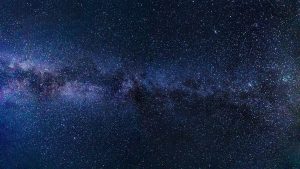
Glancing up, she saw the cosmos. A billion twinkling stars untouched by city lights and offering the potential of a trillion new worlds, hopes and dreams. A great, galactic bejeweled sky that took her breath away with both its beauty and its sheer scale.

She briefly wondered if this was what the real night sky had actually looked like? Had Jeff taken some liberties here for effect? She–much like everyone else–had never seen the residential planets’ skies and definitely never, ever sat under it at night looking at all the stars. She had been born on an outer-rim industrial planet and then been carted to the media-rim where she now lived in a streaming starship that beamed these feeds across the galaxy.

But, she was an actress and she was selling a personal role here.

“It is beautiful,” she breathed, sensually while softly squeezing the androgynous hand next to hers. All the paying viewers all over the world were cast into this supporting role. Their Conduits were also casting their consciousnesses into this Virtual Reality with hers, but they saw her and she only saw an androgynous being that was the focus of her role here.

The androgynous being said something. It was a million different somethings, one per paying customer. The program–with some help from her Chief Behaviouralist–generated a role-based, agnostic answer that she could say that would agree with almost all of the individual things each of the paying viewers had said. It was both personal and generic at the same time.

She smiled at the being and lay back in the soft grass. Had grass ever been this soft, she wondered? Were there actually entire planets covered in this wonderful stuff? She pulled the androgynous being back with her and snuggled up close to it, tucking her head into the crook of its neck and kissing it softly there.

“There is nowhere else I’d rather be,” she lied, kissing it, “than with you under these beautiful stars.” Her hand slid lower down the androgynous beings form and she leaned up and kissed it deeply on its plastic lips…

The simulation of the stars twinkled ever brighter far above the two of them on that quiet hilltop in the virtual recreation of the old Corn Belt back on some quaint planet no one could remember anymore.

***

“That was wonderful, wonderful,” her Chief Behaviorist exclaimed, as her Conduit disconnected with the program. Her eyes fluttered and then opened, immediately remembering how cold the room’s aircon was.

“In the first quartile of endorphins and some of the viewers even recorded a physical,” her Chief of Media–she could not remember his name–noted, scanning the feeds, “This one was very well received and some of the bloggers–both bot and natural–have posted positive reviews. Two stacks down, but you are starting to trend.”

She smiled and looked up. There was only a gray ceiling above her and a softly rattling aircon. Outside the media and their legions waited. She would soon be at the mercy of their views, both personal and generic.

“What are you looking at?” her Chief Behaviorist asked.

“I was just wondering if the stars actually do look like that–uh, at least how they looked in the simulation,” she asked, not expecting an answer. Her Chief Behaviourist turned to Jeff.

“Uh, yes, I believe that it is what they looked like,” began Jeff said, shrugging, “I think so–”

“But, it doesn’t matter,” her Chief Behaviourist, chimed in with his most reassuring tone, “because you are the real star, my dear. Now, let’s go speak to the media about this latest personal–”

She sighed as she got up. She was no longer listening as her Chief Behaviourist droned on. She had her prepared lines and her best fake smile. But, in the background, deeply hidden in her Conduit’s encrypted memory, she began scanning about the old Corn Belt, soft grass, and the twinkling stars. The black market often hacked her personals and offered them as replays. Maybe she would find one of those and disappear into it for a while? Maybe she would do exactly that?
Suicide Note

I do not expect you to agree with this. I do not expect you to condone it. I only expect you to do the maths. And, after that, I hope you understand it and, perhaps, even consider it yourself.

Now, about the maths…

There at least two-hundred and fifty billion stars in the Milky Way. The Milky Way is just one galaxy in around a hundred billion known or visible galaxies across all of space. If we took this as the number of stars in space and converted it to seconds in time, then this number of stars would add up to nearly eight-hundred thousand years.

In other words, if you counted these stars at a rate of one per second and never did anything else, it would still take you eight-hundred thousand years to count them. This about four times the length of time that humanity on planet Earth has been considered to be “civilized”.

We are small and insignificant in the face of this cosmic scale.

Ignoring the possibility of non-carbon-based life, carbon-based life needs to live within the Goldilocks Zone of a universe. This means that life needs a planet of sufficient size and with water and oxygen that has a stable rotation neither too far nor too close to a star. This makes it plentiful in the building blocks of life and neither too hot nor too cold for life to form.

If space has a hundred-billion multiplied by two-hundred-and-fifty-billion stars out there, then statistically some of these will have planets orbiting them within this Goldilocks Zone. Even if one in a billion of these stars has such a planet–this is 0.0000001% of these stars–then there would be literally billions of them out there.

Let us assume, once again, that only one in a billion–once again, 0.0000001%–of these planets in these infinitesimal rare Goldilocks Zones has actually evolved complex life. That would mean that there are over twenty-five thousand possible planets where complex life has actually evolved.

The Milky Way in which we reside is one of the older galaxies–but far from the oldest–so let’s assume that three-quarters of these planets that host life are younger than us. Thus, their lifeforms would probably be less evolved than us (or, potentially, still building up to creating life sometime in the future). Hence, we will ignore them as sentient, conscious beings for our purposes (though, they may well be so in the future). Hence, that would still leave over six thousand older planets that potentially hold life that is equally or more evolved than our life on Earth.

Do not forget that over long periods of time, the risks of extinction rise. It may be self-inflicted from weapons or wars, naturally driven by viruses, seismic events or weather patterns, or cosmically created by asteroids or other things hitting the planet before life has evolved technology to survive the said disaster. The point is, a large number of these older, life-holding planets would have seen extinctions that either would have reset their evolutionary clocks behind ours or completely wiped life out on these planets.

Let us assume that 99% of these older planets have had some such event–and that their life could not save itself from said mass extinction. Thus, these planets no longer factor into our calculation as these planets are now barren rocks floating out in space.

That still leaves just shy of a hundred planets were life has not just survived, but thrived. And, in so doing, is probably thousands to billions of years more evolved than we are on planet Earth floating our the Sun in the Milky Way. If you consider that planet Earth hosts a couple million life forms–almost nine million, per our last estimate–how many life forms would these rare, surviving and succeeding parent-planets hold? Perhaps approaching a billion collective types, shapes and forms of life with, at least one per planet, being more evolved and technologically advanced than we currently are.

Hence, cosmic maths dictates that it is not if alien life exists. With near certainty (per our maths above, we have given it less than one percent of a quarter chance in a billion-billionth of a percent, yet even that gives us plenty of alien life!), alien life does exist. The only variable is how much alien life exists. And, there is probably quite a lot of it too.

We are small and insignificant in the face of this cosmic scale. We are not unique in being life–or alive–and we are not unique in being conscious and having a degree of power over our destinies. We are also not unique in constantly being at threat of extinction and, statistically, we are unlikely to survive.

But why would all this life exist? Why would it matter?

Perhaps the answer–once you strip out our typically human-centric view of things–is one of statistical odds.

If “God” exists, he would not be fighting some arch-enemy that is the root of evil. Evil is a human and moral invention. Cosmically, the two differentiating things that do exist is organic matter–life!–and inorganic matter, or everything else. Rather, this God would be fighting on the side of life against its very extinction in a harsh and hostile space where life–however rare–is also fragile and statistically doomed.

If this God was making a divine gamble that life–in whatever shape or form–would survive, the best way to do this would be to diversify its shape, form, placings and sensitivities. In other words, this God would cast the dice against the inhuman, inorganic universe with only two variables in his favour: diversification and adaption.

Make lots of life. Make life of all different types. And make life spread out all over the place. This increases the odds that at least some life survives.

In other words, humans would be little more than a venture capital investment on God’s portfolio of life as he tried to protect against complete bankruptcy in the harsh, risky space and time of reality.

From thermo-nuclear super novas wiping galaxies or black holes sucking everything in, from radiation or vacuums, from viruses to changing weather patterns, from the randomness of mating and DNA to the precision of evolution over long periods of time… We are minute data points in the most incredible series of numbers amidst the most magical of experiments in the largest of all portfolios that reach scales and quantum that our mortal minds cannot fathom.

And yet we worry about what clothing we should wear? We worry if people like us or if we are getting older? We are concerned about how many likes we get on Facebook or what our neighbours are doing? We spend time wondering what to eat, to watch on TV and to say to fill the silence, but we never look or around at the cosmos or space and time. We count our bank balances and Uber rides, not the stars in the sky nor the galaxies that hold them. We judge when mere minutes go by in a queue but we barely glance at the math of space and time, nor where or how we have arrived at where we have arrived, nor even where we are going.

We are small and insignificant in the face of this cosmic scale. We are not unique in being alive and we are not unique in being conscious and having a degree of power over our destinies. We are also not unique in constantly being at threat of extinction, but we are petty in our immediate wants, desires, thoughts and actions. Our myopic consciousnesses fold in on themselves, hiding this maths from us either out of selfishness or to protect our fragile egos from its comprehension.

But is such a comprehension of this scale so terrifying? Is it so terrible that we are small data points in a grandest of statistics? Or, could this comprehension not be liberating?

We are small and insignificant, but therein lies our beauty. We can each follow our hearts and our dreams with little cosmic consequence. We need not worry about mundane things, as they really do not matter. We can carve our own meanings in this cosmic maths and find our own ways to weigh this grand scale across our lives. We need not feel guilty for going in any direction for life is both so plentiful and so scarce that we are both insignificant and a miracle. All at once.

Is it not liberating to comprehend this?

I do not expect you to understand this. I do not expect you to condone or agree with it. I only expect you to do the maths and realize the same thing I have realized: against all odds, I am alive and, against all cosmic scale, I still matter to myself. Beyond that, you are free. This appreciation is the suicide of our myopic human-centric consciousness and the birth of a beautiful, cosmically-scaled mind.

And, so, in the spirit of this planet-locked suicide, I invite you upon one of our colony starships. Earth is a few short generations from dying as is most of our solar system. Leaving our planet may be risky, but staying is riskier. Colonizing space may be risky, but not trying is riskier. Humans will likely be extinct soon, but life is plentiful out there. It will take thousands of years for us to reach the nearest galaxies, but our colony starships are self-sustaining and cryogenic stasis is now a reality. We can reach the furthest flung parts of deep space, eventually, and all the wonders that it brings with it.

All you have to do is buy a ticket. Buy a chance. Against all odds, you are alive and you still matter to us. So, do the math, and buy a ticket.

Kind regards,

Colony Recruitment Agency

2146 AD